
Welcome to the Precision Muon Physics Group
at the University of Washington
Introduction
The Precision Muon Physics Group joined CENPA in 2010. Our mission is to identify compelling, precision experiments that either determine fundamental quantities in physics or sensitively test the Standard Model. Students and postdocs in our group take on leading roles in hardware design and development, all operational aspects of running a complex beam experiment, Monte Carlo simulation, data analysis, and presentation. As a rule, we work collectively on all experiments, but each group member has a specific main focus.
Scientific Motivation
Defining the parameters of the (new) Standard Model (SM) is a high priority of both particle and nuclear physicists. Important advances come from efforts to produce high-mass particles at colliders and symbiotically from precision low-energy measurements. These techniques give a glimpse into the fundamental nature of the SM. The exciting LHC discovery of the Higgs boson with mass 125 GeV/c2 helped stimulate the next generation of study. Truly understanding the fundamental physics and establishing model parameters will require data from a host of complementary precision measurements. Among these are neutrino mixing-angle and mass measurements (other CENPA expertise!), and the search for neutrinoless double beta decay (again, CENPA experts). They include high-precision comparisons of SM predictions with measurement, such as the muon’s anomalous magnetic moment, or the running of the weak mixing angle. Technological and facility advances will allow great strides forward in high-sensitivity searches for the permanent electric dipole moments of the neutron, electron, and certain atoms (UW leading effort); in select rare kaon decays; and in charged lepton flavor violation tests for muons and taus. Collectively, these low-energy precision experiments are part of the New Standard Model Initiative as prioritized in the 2007 Long Range Plan for Nuclear Science, and emphasized in the 2015 Long Range Plan. They are, in general, interdisciplinary efforts where nuclear physicists either lead or work in close partnership with high-energy and atomic physicists at a variety of facilities worldwide.
Selected Publications
Physics Articles
Measurement of the Positive Muon Anomalous Magnetic Moment to 0.46 ppm (Muon g-2, 2021)
Magnetic-field measurement and analysis for the Muon g-2 Experiment at Fermilab (Muon g-2, 2021)
Beam dynamics corrections to the Run-1 measurement of the muon anomalous magnetic moment at Fermilab (Muon g-2, 2021)
Measurement of the Formation Rate of Muonic Hydrogen Molecules (MuCap, 2015)
Technical Publications
Studies of an array of PbF2 Cherenkov crystals with large-area SiPM readout (Muon g-2, 2015)
A high-pressure hydrogen time projection chamber for the MuCap experiment (MuCap, 2014)
A Circulating Hydrogen Ultra-High Purification System for the MuCap Experiment (MuCap, 2007)
Physics Review Articles
Nucleon axial radius and muonic hydrogen—a new analysis and review (2018)
Press for recent Muon g-2 Result
Links to selected press articles
Group Members
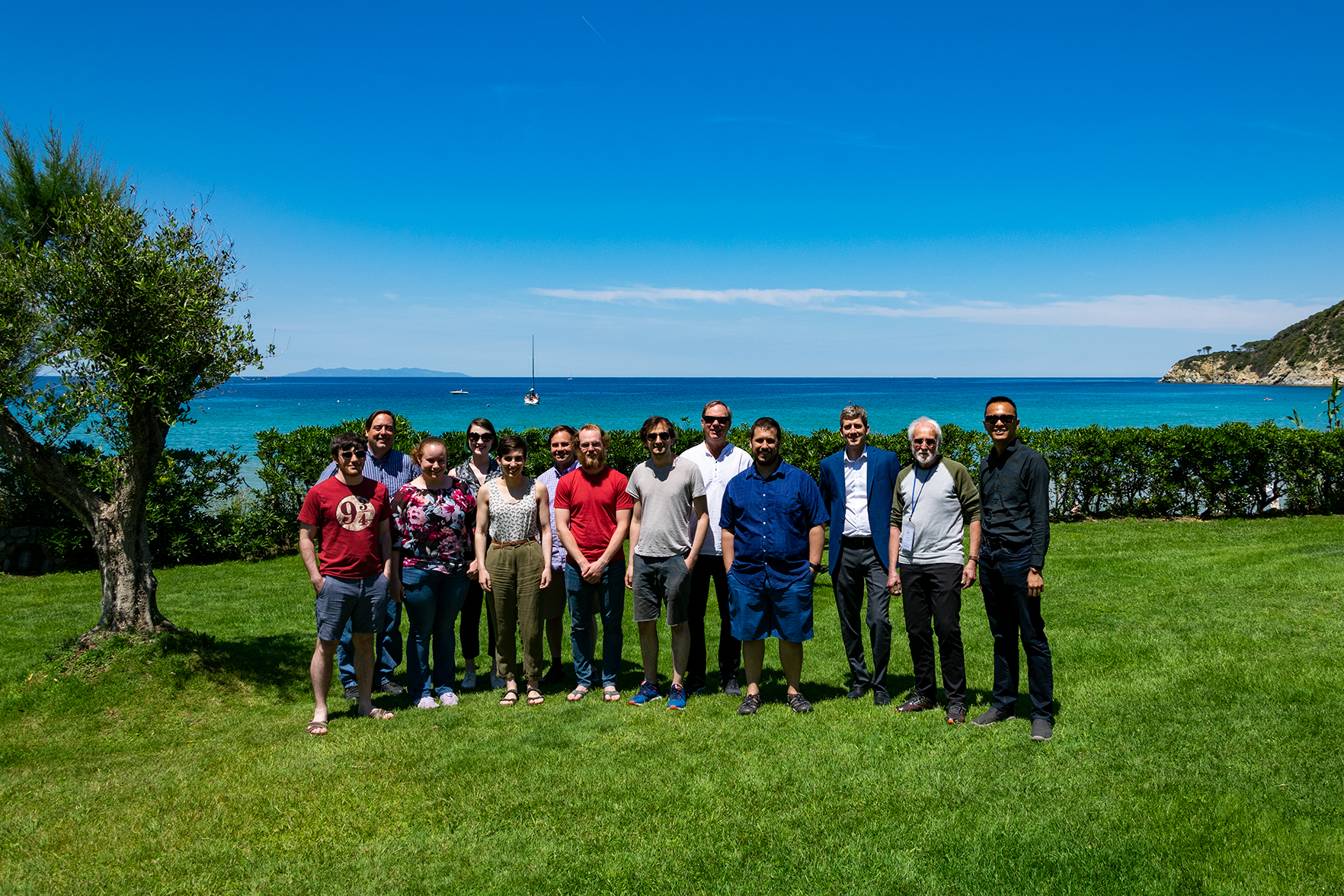
Current and former UW Muon g-2 group members at the Muon g-2 Collaboration Meeting in Elba, Italy, 2019
Back row, left to right: Chris Polly, Brynn MacCoy, Fred Gray, Dave Hertzog, Peter Winter
Front row, left to right: Josh LaBounty, Rachel Osofsky, Hannah Binney, Jason Hempstead, Aaron Fienberg, Brendan Kiburg, Erik Swanson, Kim Siang Khaw
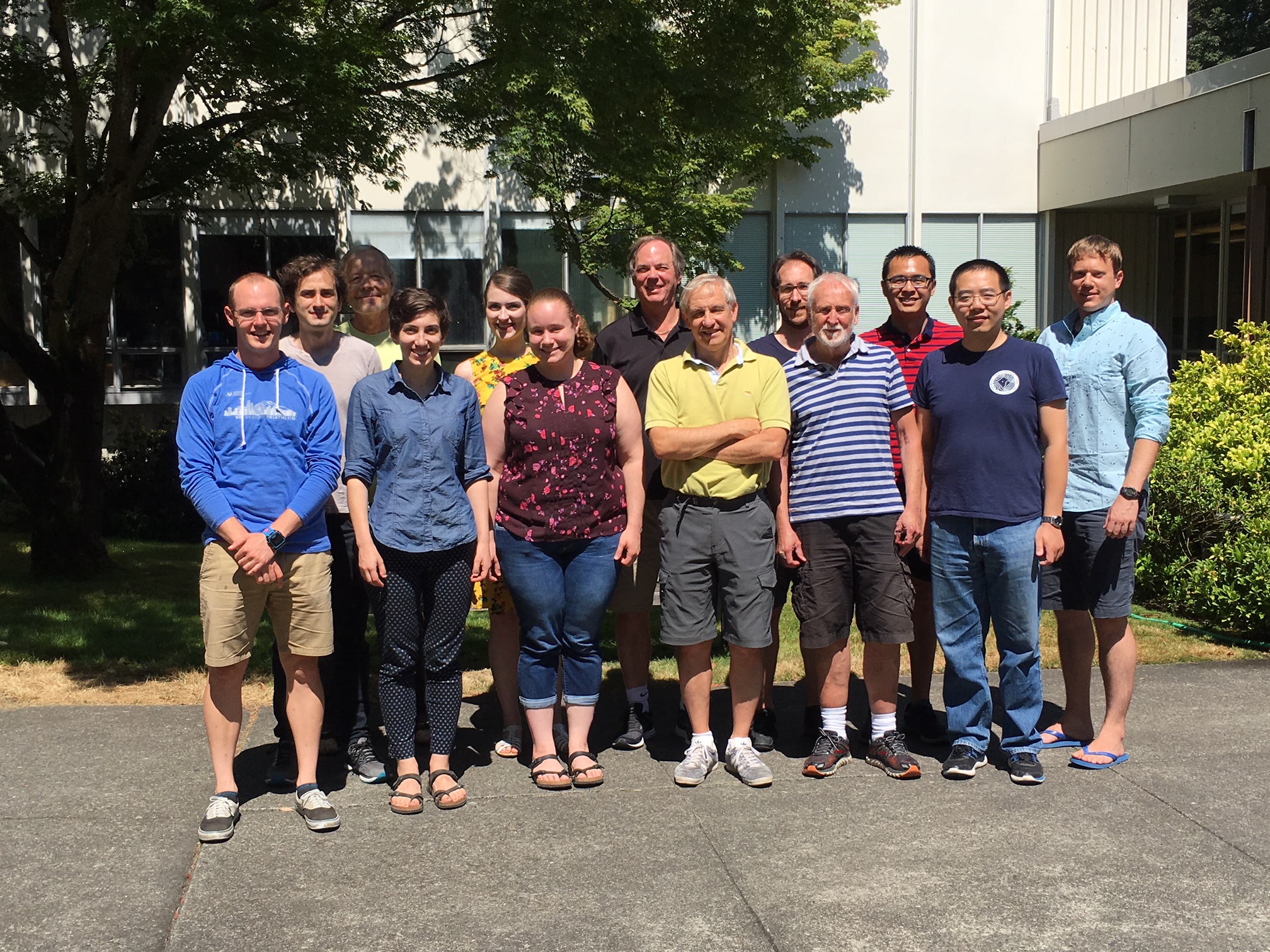
Current and former UW Muon g-2 group members at CENPA
Back row, left to right: Aaron Fienberg, Peter Kammel, Brynn MacCoy, Dave Hertzog, Martin Fertl, Kim Siang Khaw, Nathan Froemming
Front row, left to right: Jason Hempstead, Hannah Binney, Rachel Osofsky, Alejandro Garcia, Ran Hong
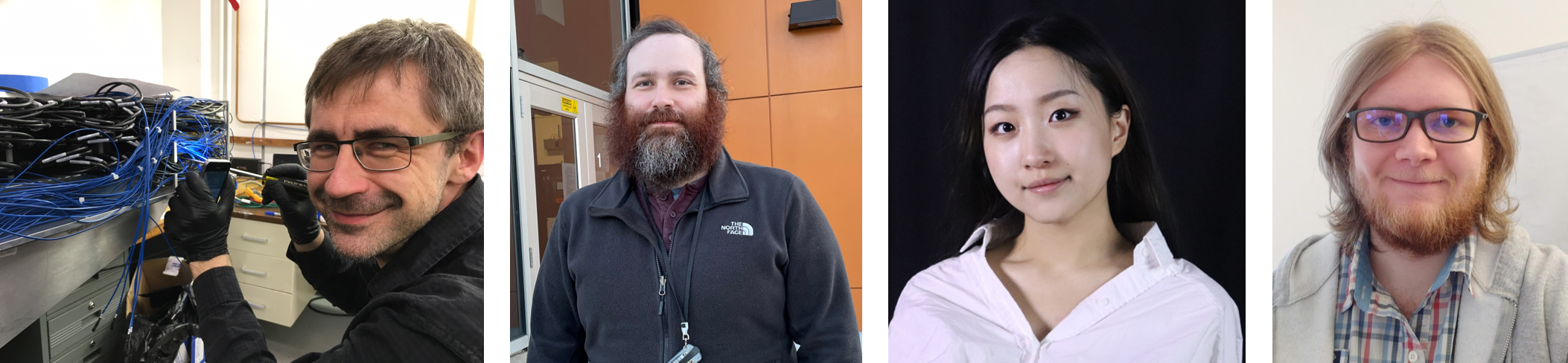
Other current UW Muon g-2 group members
Left to right: Jarek Kaspar, Zachary Hodge, Angela Zhou (undergraduate), Lars Borchert (undergraduate)
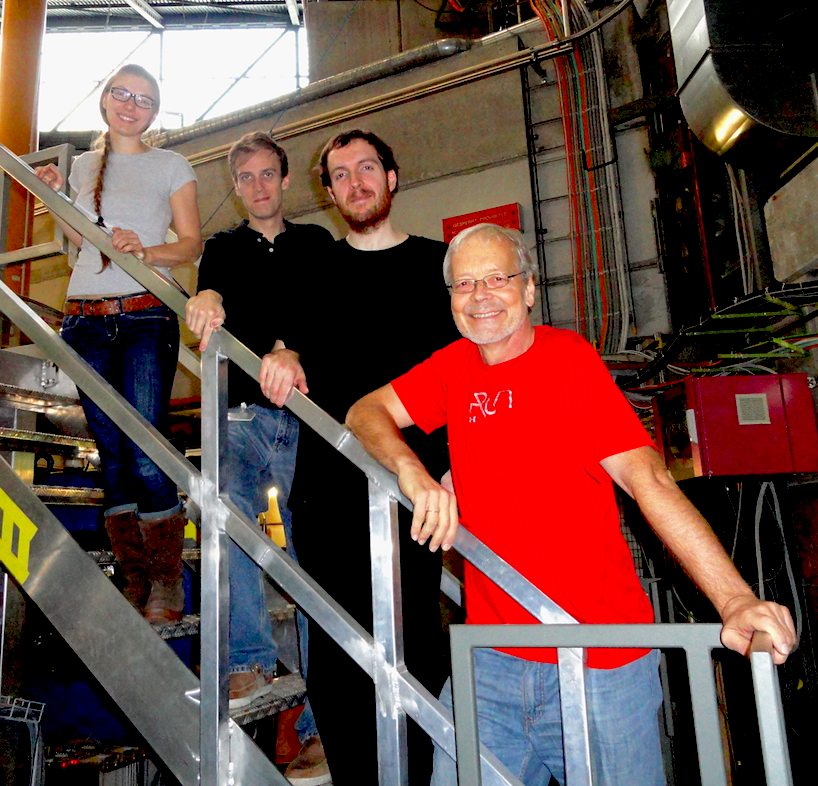
Current and former UW MuSun group members
Left to right: Rachel Ryan, Dan Salvat, Ethan Muldoon, Peter Kammel
(Not pictured: Duncan Prindle)
Faculty/Research Scientists
Post Doctoral Research Associates
Muon g-2
Zachary Hodge (zhodge@uw.edu)
Graduate Students
Muon g-2
Jason Hempstead (hempste@uw.edu)
Brynn MacCoy (maccob@uw.edu)
Hannah Binney (hbinney@uw.edu)
Josh LaBounty (jjlab@uw.edu)
MuSun
Ethan Muldoon (ethanm3@uw.edu)
Undergraduate and Exchange Students
Muon g-2
Lars Borchert
Angela Zhou
Former Graduate Students
Rachel Osofsky - 2019 - Magnetic Field Determination for Run 1 of the Fermilab Muon g-2 Experiment
Rachel Ryan - 2019 - MuSun - A Precision Measurement of Nuclear Muon Capture in Deuterium with a Cryogenic Time Projection Chamber
Aaron Fienberg - 2019 - Measuring the Precession Frequency in the E989 Muon g-2 experiment
Nathan Froemming - 2018 - Optimization of Muon Injection and Storage in the Fermilab g-2 Experiment: From Simulation to Reality
Matthias Smith - 2017 - Developing the Precision Magnetic Field For the E989 Muon g-2 experiment
Jason Crnkovic - 2013 - Measurement of the e+e- ->pi+pi-pi0 cross section by the radiative return method using Belle Data
Sara Knaack - 2012 - A Determination of the Formation Rate of Muonic Hydrogen Molecules in the MuCap Experiment
Brendan Kiburg - 2011 - A Measurement of the Rate of Muon Capture in an Ultra-Pure Protium Gas Time Projection Chamber
David Webber - 2010 - A Part-Per-Million Measurement of the Positive Muon Lifetime and a Determination of the Fermi Constant
Steven Clayton - 2007 - Measurement of the Rate of Muon Capture in Hydrogen Gas and Determination of the Proton's Pseudoscalar Coupling
Dan Chitwood - 2007 - A Measurement of the Mean Life of the Positive Muon to a Precision of 11 Parts per Million
Chris Polly - 2005 - A Measurement of the Anomalous Magnetic Moment of the Negative Muon to 0.7 PPM
Fred Gray - 2003 - A Measurement of the Anomalous Magentic Moment of the Positive Muon with a Precision of 0.7 Parts Per Million
Brian Bunker - 1998 - A Scan of the Cross Section σ(p ̅p⟶ΛΣ^0+c.c.) from Threshold to 2.5 MeV Excess Energy
Johannes Ritter - 1998 - A Measurement of the Reactions pp -> ee, pp -> pi0e and pp -> pi0pi0 from 1.188 GeV/c to 1.445 GeV/c
Paul Reimer - 1996 - A Measurement of the pp -> KsKs Reaction from 0.609 to 1.9 GeV/c
Timothy Jones - 1996 - A Measurement of pp -> LL Near Threshold
Rex Tayloe - 1995 - A Measurement of the pp -> LL and pp -> SL + c.c. Reactions at 1.726 GeV/c
Former Postdoctoral RAs
Experiments
Current Experiments
| Webpage | Fermilab, Batavia, IL | ||
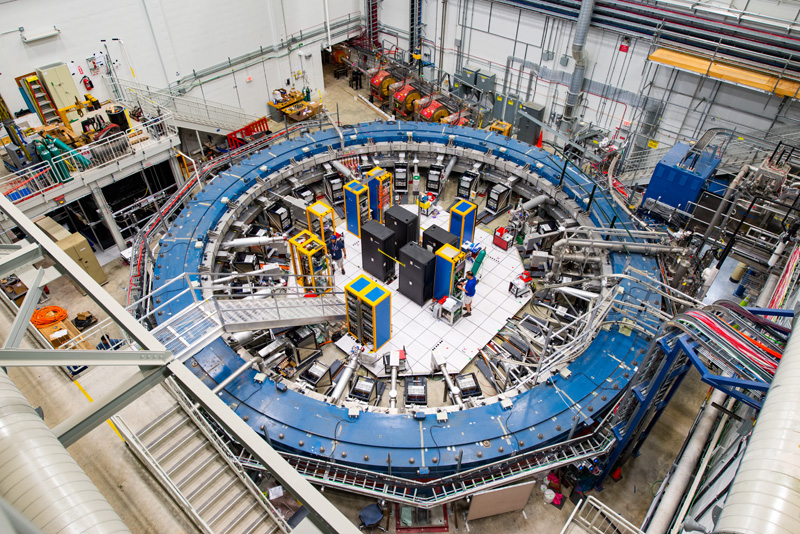 |
The anomalous magnetic moment of the muon was last measured in 2004 to a precision of 540 parts per billion (ppb) by the E821 Muon g-2 Experiment at Brookhaven National Laboratory. Comparisons with current (2020, https://muon-gm2-theory.illinois.edu/) standard model calculations indicated a >3 sigma discrepancy between theoretical predictions and experiment. This is a strong hint of new physics, and represents a stringent test of the standard model. The implications are profound as the magnitude of the deviation locks squarely with predictions by many supersymmetric models and implies mass scales that are quite accessible at the Large Hadron Collider. The Muon g-2 Experiment at Fermilab (E989) aims to improve the precision of the experimental value by a factor of 4. The group at UW was heavily involved in forming the new collaboration (with Prof. Hertzog serving as co-spokesperson) --- helping to relocate the ring magnet from Brookhaven National Laboratory to Fermilab, designing beamline strategies, and prototyping new detectors. Since then, we have been one of the largest groups within the collaboration, contributing to each aspect of the measurement. In particular the UW group has:
as well as many more ongoing contributions. Results from Run-1 of the Muon g-2 Experiment were published on April 7, 2021, generating worldwide excitement in popular and scientific news. Run-1, with its precision of 460 ppb, represents a dataset of similar size to the total E821 dataset. Future runs with larger datasets will further improve this precision toward the ultimate goal of 140 ppb. Run-2 and Run-3, collected in 2018-2020, are expected to double the combined precision. Run-4 is being collected as of 2020-2021, and Run-5 is planned to begin in 2021. Image Credit: Fermilab. |
||
| TWiki | Webpage | PSI - Villigen, Switzerland | |
|
|
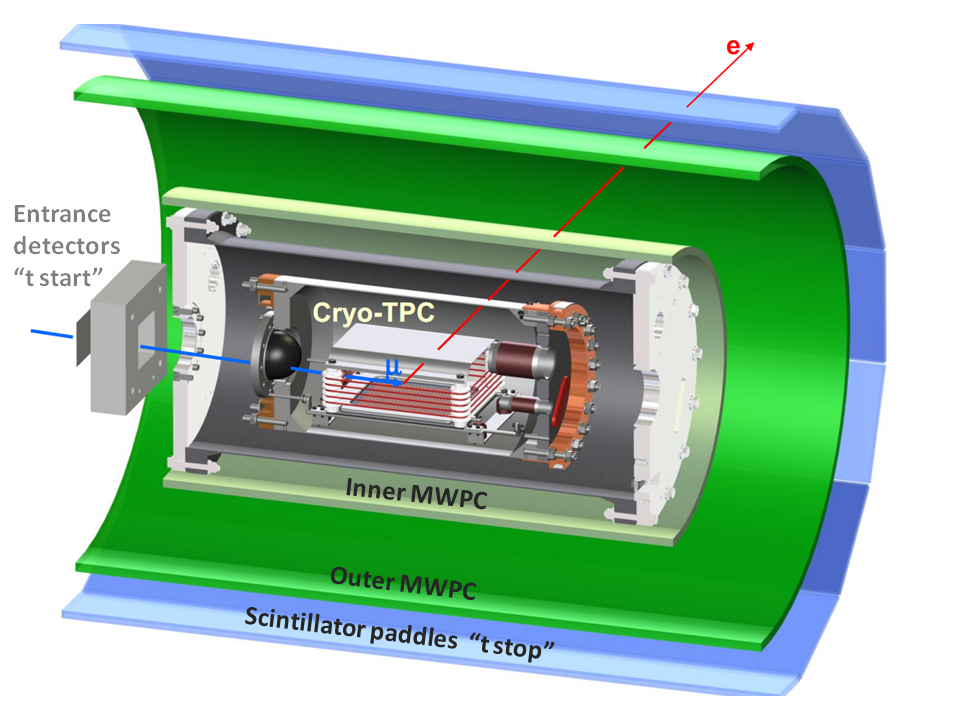
MuSun (Kammel co-spokesperson) will measure muon capture on the deuteron, the simplest weak interaction process on a nucleus that can both be calculated and measured with high precision. Modern QCD-based theories relate capture to one of the most important nuclear reactions of the universe—weak pp capture—which is the main source of energy in the Sun. It is also related to the ν+d reactions detected by the Sudbury Neutrino Observatory with significant participation of CENPA. To the required precision, these reactions depend on a single parameter, which characterizes poorly known aspects of the two-nucleon axial current. MuSun will be the first precision measurement of this constant in the 2N sector and will help to calibrate the basic astrophysics reactions. The technique is unique, as it relies on a cryogenic time-projection-chamber, with critical developments in our UW laboratories. |
||
| Location TBD | |
|
|
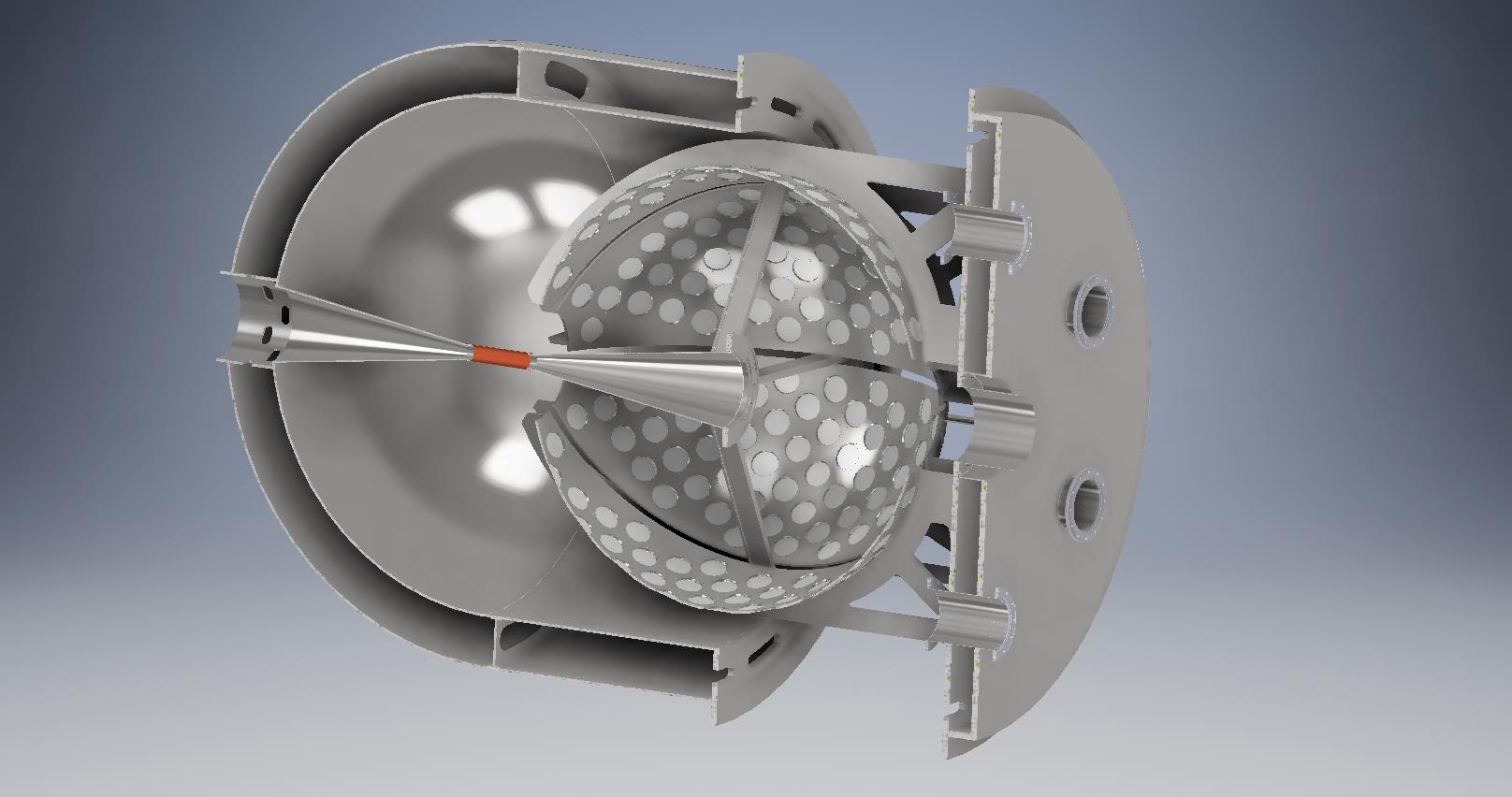
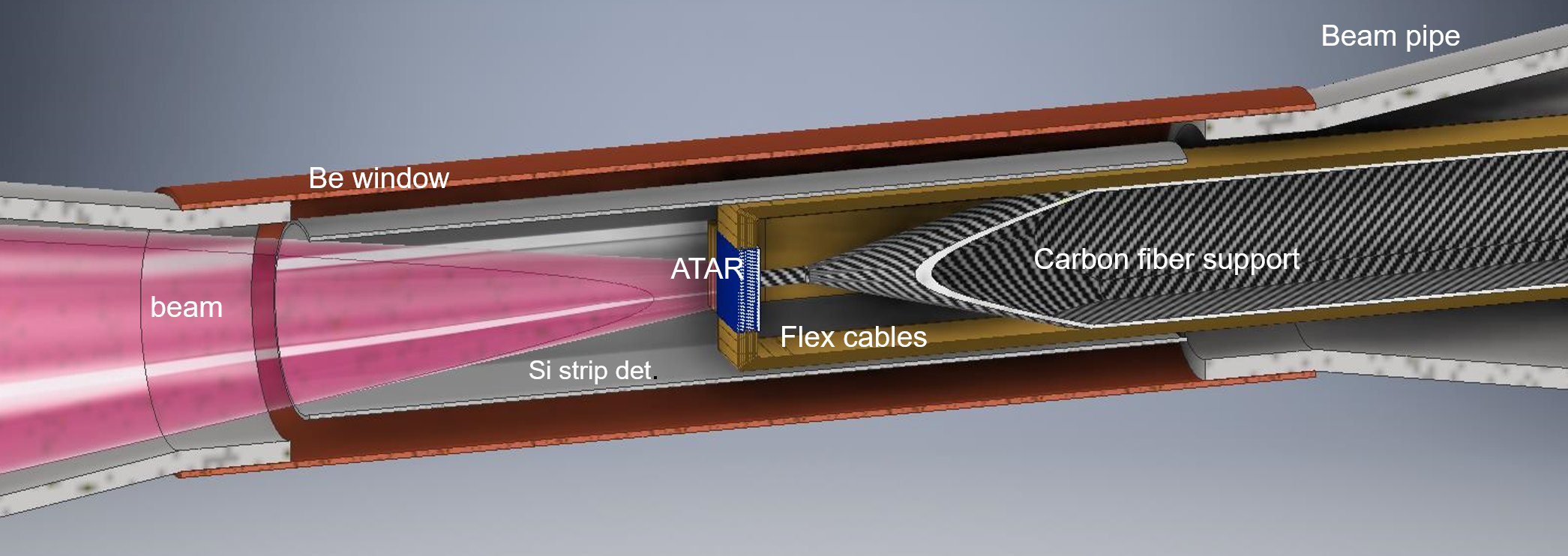
Recently, work has begun on a next generation experiment to measure the charged-pion branching ratio to electrons vs. muons. This measurment, which is highly sensitive to new physics at high mass scales, has broad implications for the universality of lepton interactions. Using state-of-the-art instrumentation - learning from the previous generation PEN and PiENu measurements - and a new high-intensity beam, measurements of the pion decay to electrons vs. muons and pion beta decay will improve on previous studies by an order of magnitude to the 10-4 precision level. A disagreement with the theoretical Standard Model(SM) prediction, which has a remarkable precision at the same level, would unambigously imply new physics beyond the SM. Further motivation comes from the muon g-2 discrepancy and intriguing hints for lepton flavor violation in the B sector. Exotic rare decays involving sterile neutrinos and axions will also be searched for with unprecedented sensitivity. Simulations of detector geometry are well underway, making use of the computing cluster at CENPA, and a letter of intent was recently submitted to begin the process of making the experiment a reality. Design of the experimental apparatus, which consists of an 80 cm sphere of liquid Xenon, surrounding a beampipe and active target, is being spearheaded by UW Muon group members and CENPA engineers. |
Completed efforts
| PSI - Villigen, Switzerland | |||
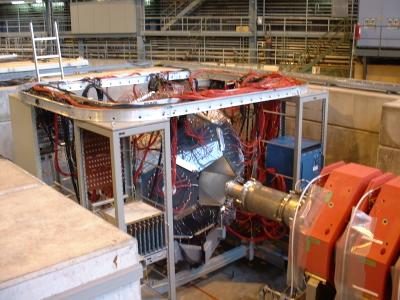 |
The Muon Lifetime Analysis (MuLan) experiment (Hertzog co-spokesperson) recently completed a measurement of the positive muon lifetime to a precision of 1.0 ppm (part per million), the most precise particle lifetime ever measured. The muon lifetime provides the most precise determination of the Fermi coupling constant, which is one of the fundamental inputs to the Standard Model. Recent advances in theory have reduced the theoretical uncertainty on the Fermi coupling constant as calculated from the muon lifetime to a few tenths of a ppm. The remaining uncertainty on the Fermi constant is entirely experimental, and is dominated by the uncertainty on the muon lifetime. The MuLan experiment used an innovative pulsed beam, a symmetric detector, and modern data-taking methods to obtain more than 2x10¹² events. The result has been published in PRL: http://prl.aps.org/abstract/PRL/v106/i4/e041803. | ||
| TWiki | Webpage | PSI - Villigen, Switzerland | |
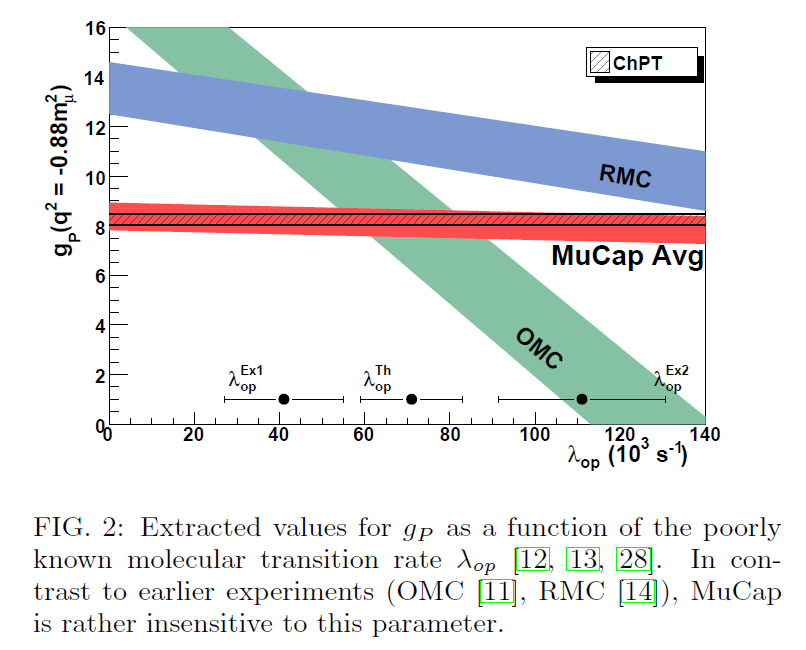 |
The µCap experiment (Kammel co-spokesperson) was a 1% precision measurement of the muon capture rate on the proton. From the capture rate the pseudoscalar form factor gP of the nucleon was extracted with 7% precision. This basic quantity is predicted theoretically with high precision, but the experimental situation was quite controversial. The experiments were based on a novel method utilizing a time-projection-chamber filled with ultrapure pressurized hydrogen gas. This technique eliminates many uncertainies plaguing earlier experiments. The result was an unambiguous value for gP and a sensitive test of the chiral symmetry of QCD at low energies. Check out the latest result on the arXiv: http://arxiv.org/abs/1210.6545 | ||